
Turning local knowledge into cooler, fairer streets
As Australian summers become longer and more intense, the way our neighbourhoods are designed is increasingly shaping how safe and comfortable they are to live in. This week, Sweltering Cities is releasing a new resource to help communities take action: the Cool Walks Toolkit.
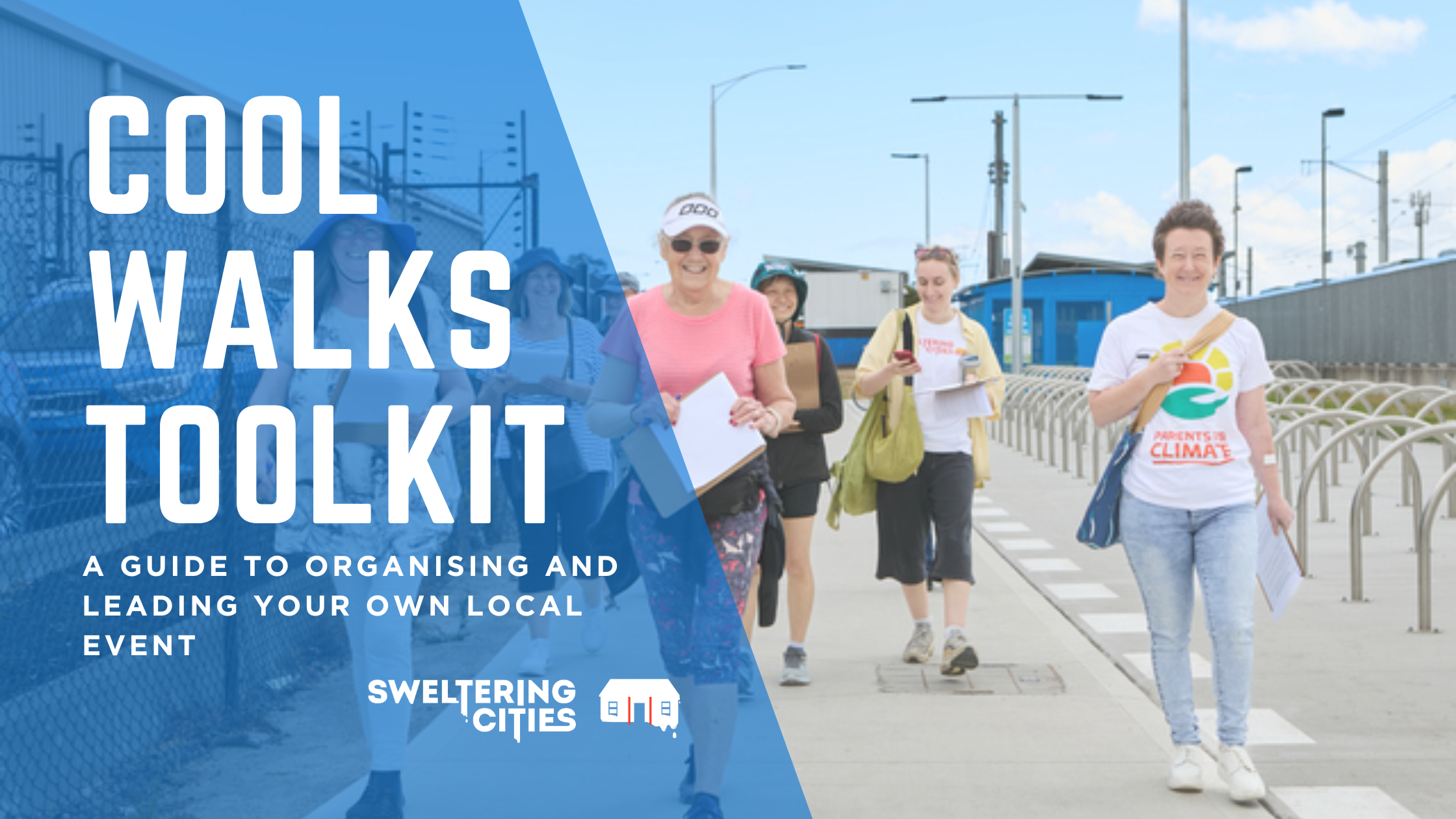
Developed in collaboration with the City of Casey, and informed by our multiple Cool Walks over the last two years in Melbourne, Sydney, and Perth, the toolkit is designed to make it easy for anyone to run their own Cool Walk and start conversations about heat in their local area.


Why Cool Walks?
Extreme heat is one of the most pressing climate risks facing Australian communities. But it doesn’t affect everyone equally, and it doesn’t show up the same way in every street.
Two people living in the same suburb can have very different experiences of heat depending on their surroundings. If you’re young and fit the heat may have no effect on you, but for older people, people with disabilities, or parents with young children the heat is often unbearable.
Cool Walks help make these differences visible.
The way we design and build our suburbs determines just how safe our communities are during extreme heat. From tree lined streets, to bus shelters, and playgrounds with shade and water fountains – Cool Walks demonstrate how heat-resilience can be better incorporated into our local areas.
By walking through a neighbourhood together, people can experience firsthand how the built environment shapes heat exposure. It turns something that can feel abstract, like urban heat, into something immediate, tangible and shared.
What is in the Toolkit?
The toolkit breaks down running your own Cool Walk into five easy steps.
- Research your local area – Understand where and why heat is a problem locally, and look up what your local council is already doing to help combat these issues.
- Plan your route – Aim for a 20-30 minute walk that goes through stops including a train station, parks, intersections, and bus stops.
- Prepare your questions – Think about what questions to ask your group to keep discussions flowing and get people to think about what makes a space refreshingly cool, or unbearably hot.
- Invite your community and lead your walk – Find a group of like-minded people, set a date and time, and lead your walk!
- Turn your observations into actions – Gather the data from your walk and take them to your local council and be the start of change in your neighbourhood.
The toolkit also includes:
- Practical tips for a smooth walk
- How to make your walk inclusive
- How to share your findings and create change
- A facilitator guide and worksheet that you can print out and take with you on your walk to make it as easy as possible
The power of observing the built environment
We often rely on data, reports and modelling to understand heat. These are essential, but they don’t always capture the lived reality of moving through a place on a hot day. That’s where community observation plays a powerful role.
Cool Walks centre the knowledge of people who live, work and travel through these areas every day. They highlight the details that matter like where shade is lacking, where waiting for public transport becomes unsafe, or where a park offers relief.
These observations can reveal patterns that are easy to miss in high-level planning. They also help connect big-picture climate challenges to practical, local solutions, like more trees, better shelter, safer crossings, and cooler materials.
Just as importantly, they create space for people to share experiences, build a common understanding, and imagine what a cooler and safer neighbourhood could look like.


From local walks to collective action
Cool Walks are not just about identifying problems. They are a starting point for action.
When communities come together to document their experiences, they create a strong, evidence-based story about what needs to change. These insights can support conversations with local councils, inform planning decisions, and contribute to broader efforts to make cities more climate-resilient.
The Cool Walks we’ve already held in Melbourne, Sydney and Perth showed just how valuable this process can be. Participants identified clear contrasts between hot and cool areas, shared ideas for improvement, and helped build momentum for ongoing discussions about urban heat in their suburbs.
The new toolkit builds on these experiences, offering a simple, flexible framework that communities across Australia can adapt to their own context.
If you would like to support us to continue to provide these free community resources, you can make a donation here.
Give it a try
You don’t need to be an expert to run a Cool Walk. Whether you’re part of a community group, a local organisation, or just someone who cares about making your neighbourhood more liveable, the toolkit is designed to guide you through the process. Running a Cool Walk can be as simple as gathering a small group, choosing a route, and starting a conversation.
What matters most is paying attention to the spaces we move through every day, and asking how they could be safer, cooler and more inclusive, especially as summers get increasingly hotter.
By running your own Cool Walk and sharing what you learn, you’ll be contributing to a growing national picture of how heat is experienced at a local level, and helping build the case for change.
