In 2026 the NSW Government is considering whether there should be Minimum Energy Efficiency Standards for rental homes in our state. We think this is a no-brainer; everyone deserves to live in an affordable, safe, and healthy home.
Renters are baking in dangerously hot homes every summer, and it’s getting worse. Climate change means hotter summers and longer, hotter and more frequent heatwaves. This is bad news for everyone, but especially renters, who are more likely to live in poorly built, low energy efficient homes with no power to make changes to the properties they live in.
We have a plan to mobilise hundreds of renters, experts and leaders to demonstrate why heat safe homes are essential. This campaign will only be a success if we work together. On this page you’ll find information about the health risks of dangerously hot homes, how minimum standards will help manage cost of living pressures, how you can make your voice heard and how you can talk to other people about adding theirs.


Have you already made a submission? Let us know here so that we can keep you in the loop about what happens next.
NSW Renters spotlight report
The ‘Hot at Home: The case for rental minimum standards in NSW’ report has the facts on the cost of low energy efficiency homes, stories from renters, unpublished information from our 2026 Summer Survey, and everything you need to know about why NSW needs heat safe rentals and what policies will help make that happen.

The Facts
Nowadays, about 1 in 3 Australians rent, and many more people are renting long-term. 55% of all renting households are families with children. The number of renting households has grown by over 17.5% since 2016. People are retiring as renters, and more children are growing up in rental households.
Our 2026 Summer Survey found that:
- 85% of respondents in NSW supported heat safety standards for rental homes.
- 81% of respondents who identified as renters reported feeling unwell in the heat
- While 82% of respondents had aircon at home, 61% avoid turning it on due to cost
- 34% of renters worried about the cost of energy daily
Heat-related health risks: Extreme heat events are deadlier than all other environmental disasters combined and extreme heat related deaths are projected to increase as summers become hotter and more severe. Renters, who are more vulnerable to extreme heat due to the quality of their homes, are at greater risk of experiencing heat-related illnesses or dying due to heat. Within the 2026 Summer Survey, the most common mental and physical health impacts of extreme heat among renters were: dehydration, dizziness, exhaustion and lethargy, migraines, heatstress, fainting, and negative impacts on sleep.
Cold-related health risks: Cold is also a killer in Australia. 6.5% of deaths are attributable to cold: about 1 in 15. Living in poorly insulated homes can lead to respiratory problems, cardiovascular issues, and other cold-related illnesses, particularly among vulnerable populations such as children, the elderly, and those with pre-existing health conditions.
Mental health: Constant exposure to uncomfortable temperatures can also take a toll on mental well-being, leading to increased stress, anxiety, and depression among renters. Research also shows us that instances of domestic and family violence increase during extreme weather events, as do presentations to hospital emergency departments.
Higher Energy Bills: Inefficient and poorly insulated homes result in higher energy bills as renters struggle to maintain comfortable temperatures throughout the year. This places additional financial strain on households already struggling with the high cost of living. The number of people in energy debt has been increasing as more people fall behind on their bills.
Healthcare Expenses: Health issues resulting from living in substandard homes can lead to increased healthcare expenses, including medical consultations, prescriptions, and hospitalisations, further exacerbating financial stress for renters.
Dangers at school and work: Uncomfortable living conditions can also impact renters’ ability to work or study effectively, potentially leading to difficulty concentrating, reduced productivity and income loss.
The Solutions
- Common sense energy efficiency solutions
Better blinds, screen doors and fly screens, draft-proofing and other affordable and easy to install solutions make homes warmer in winter and cooler in summer. Unfortunately, too many renters can’t make these simple alterations. Energy efficiency standards can make these common sense solutions mandatory or easier to request. - Insulation makes a big difference
Insulation works by slowing down the transfer of heat; stopping warmth from escaping through the ceiling, walls and floor in winter, and stopping the sun’s heat from entering in summer, helping homes stay comfortable all year round and reducing the need for heating and cooling. The ACT and Victoria both have minimum insulation standards for rentals. - Cooling for people who need it
Some homes will be dangerously hot because of their design or location. In these cases, air conditioning can be the only way to easily cool the space to safe temperatures. However, air conditioning can also be too expensive for people to rely on and forces people to choose between cooling and other essentials. Air conditioning will be essential for some, but by itself isn’t a good solution for energy efficiency. - Protections for Renters
The cost of energy efficiency upgrades should not be passed on to renters. Too many people are already in housing stress and are anxious that new standards will mean higher rent. Evidence from the ACT and UK show that higher standards hasn’t led to higher rents, but there should be protections for renters for housing that is safe, affordable and healthy.
FAQ
What is the May 2026 consultation about?
The NSW Government is investigating minimum energy efficiency performance standards for rental housing. Minimum energy efficiency rental standards (MEERS) set out mandatory energy-related requirements that rental homes must meet before they can be leased.
If introduced in New South Wales, MEERS could require energy efficiency features such as a level of insulation or a standard for heating and cooling systems, or set out a minimum energy performance rating that rental homes need to achieve through a combination of features. The new standards would build on the existing minimum rental standards which outline existing requirements for rental homes, including that they must be structurally sound, have adequate ventilation and adequate drainage according to the Residential Tenancies Act 2010 (NSW). Other jurisdictions have already implemented MEERS to improve the thermal safety and energy efficiency of rental homes, including the Australian Capital Territory, Victoria, New Zealand, France and the United Kingdom.
Why do we need minimum standards?
Renters make up about one‑third of households in New South Wales. Rental homes are less energy-efficient than owner-occupied homes by a significant margin. Only 22% of NSW rental homes have insulation, compared with 54% of owner-occupier homes. On renewables, only 10% of NSW renters had rooftop solar in 2024 compared to 38% of home owners (Baker et al. 2025). Introducing MEERS in New South Wales would lift the quality of rental homes and make them safer, more comfortable, healthier and cheaper to run.
What happens after the consultation?
The NSW Department of Climate Change, Energy, the Environment and Water (DCCEEW) and NSW Fair Trading are investigating adopting MEERS in NSW. The investigation will deliver a report in 2026 to the NSW Government on:
- whether to implement MEERS in NSW
- if so, initial recommendations on preferred standards and implementation models ; and
- an analysis of the benefits and costs of implementing MEERS
After the submission period closes on May 31st 2026, the Department will consider the results and deliver a report to Cabinet by the end of the year. Even after the consultation closes, it will be important to keep up the pressure on the NSW Government to make the right decision.
Who should make a submission?
Anyone can make a submission! You don’t need to be a renter, or an expert. If you care about the issue or have a story or point of view, your voice is important. We’re hoping that thousands of people participate in the consultation period. This will show the diverse voices who are in favour of safe and healthy homes. Your submission can be short and personal, or long and detailed – everything helps.
“Electricity is way too expensive, but we need the fans on throughout the day and even the night. The insulation sucks here, so it’s always hot inside. Always. Can’t afford to get air conditioning, or even pay my electricity bill which has been soaring this summer”
— NSW Renter in the 2026 Summer Survey
Getting the word out
Talk to your housemates or friends
1. Set a time
Saturday morning over coffee? After dinner on Tuesday? Pick a time when people will be around and have 20-30 minutes to talk. You can lure people with snacks to fuel conversation.
2. Send them the info
You can print or email our Heat Safe Rentals Report or email them a link to this page so they’re prepared with ideas and questions.
3. Talk about why it’s important
Make time to talk about what it would mean to live in a more energy efficiency home. How would a cooler home in summer and a warmer home in winter benefit you and how would it benefit other people in the community? If your energy bills were lower how would that affect your life?
4. Make your submissions
There’s three ways to add your voice. You can send us a comment that we’ll include in our submission, you can make a submission by email (and CC us please), or you can fill in the consultation survey. Let us know if you make a submission so we can keep you in the loop about next steps and let people know how many people cared enough to make a submission.

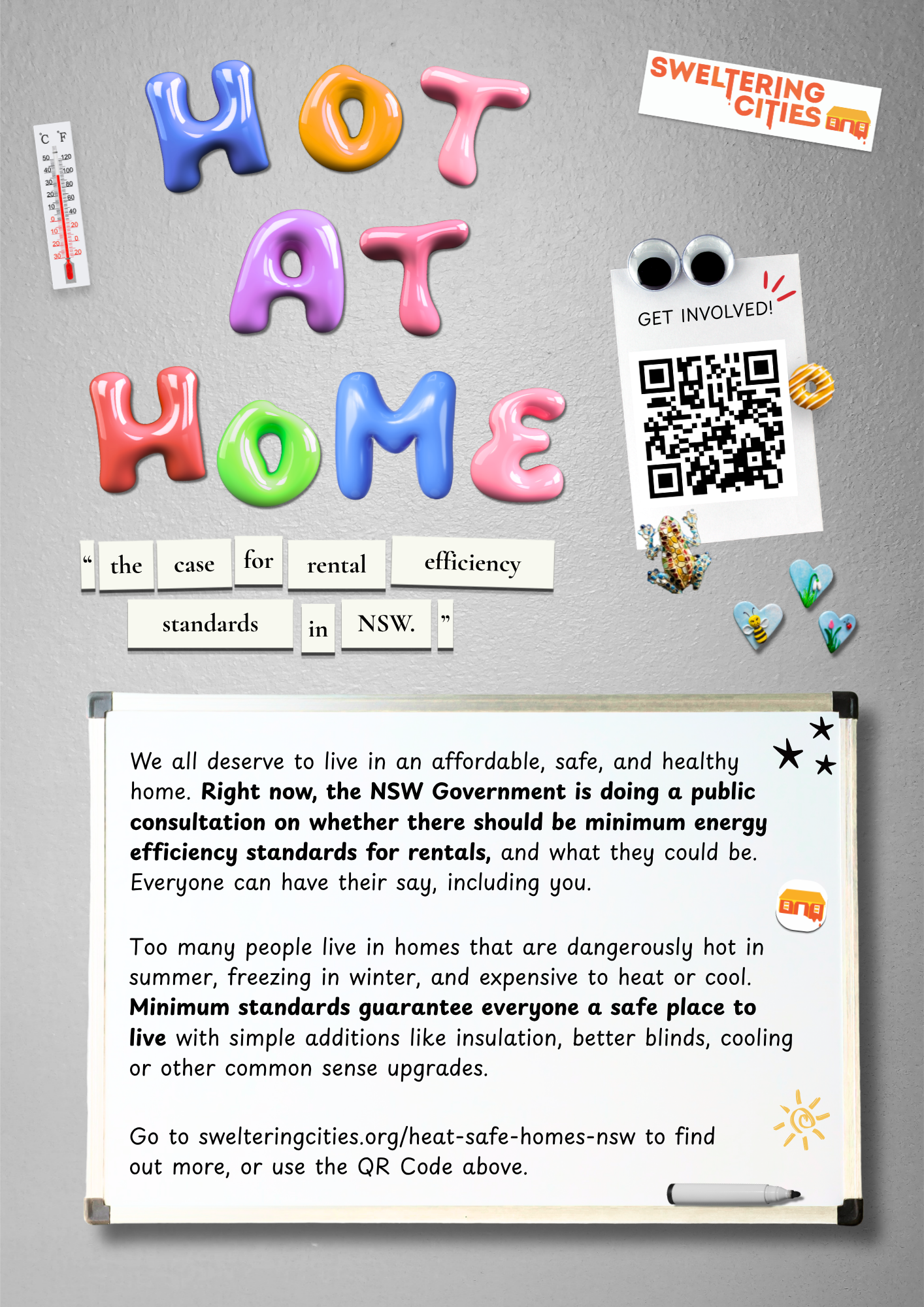
Download this poster and send it to people, or print it out to put up in your apartment building or at a local cafe.
Follow us on social media to keep up to date on campaign news!