
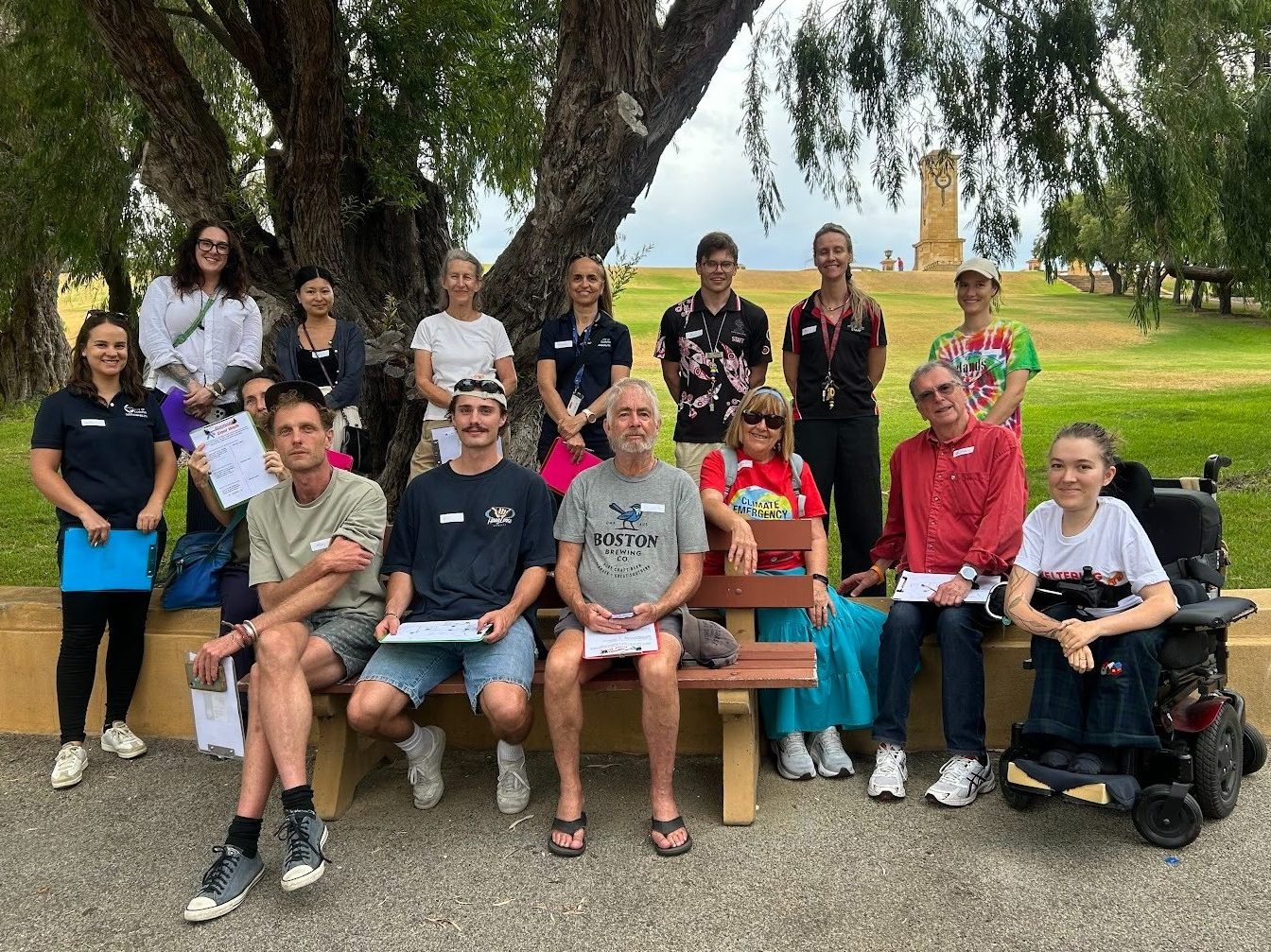
On Monday 9th of Feb, we held our very first WA Community Cool Walk through a pocket of Fremantle. 14 community members joined us to reflect on the ways in which existing spaces and structures impact the happiness, health and heat-resilience of our communities.
Perth was on the tail-end of a series of sweltering days, but on this particular Monday afternoon plump tropical clouds swelled across the ocean, and above in the skies, providing a cool and welcome change for our walkers to reflect on a hot topic: Does the way our suburbs are designed and built make it easier or harder to live, work and play on hot summer days?

The walk itself had been designed around 5 key stops, which had been carefully coordinated to allow our participants to compare and contrast old and new design; along with public, private and grassroots approaches to the issue of heat. Lively discussions were had at each stop along our route. Key insights from the Community Cool Walk included:
- The importance of canopy and shade in our homes, parks, public spaces and public transport stops/stations – cool spaces to beat the heat
- An appetite for more info and access to sustainable design principles for keeping our homes cool, including building materials, passive design principles and infrastructure for cooling
- While heat impacts us all, some people in the community are more vulnerable than others, including the elderly, children, people with a disability, renters, people working outside
- We noticed and reflected in the lack of equity in the housing sector, with the infrastructure, design, amenity and maintenance in many public and social housing buildings inadequate, obsolete and potentially hazardous
- We discussed the importance of community spaces for connection, common use and common purpose
- The impact of heat on pets and birdlife, and the need to prioritise habitat, shelter and water for our furry and feathered friends
The results

Stop A – knutsford St Reserve
Knutsford St Reserve is a public park/playground on a corner block. There are some beautiful trees near the park, the play area itself has no shade, no drinking fountain and limited seating. The playground is built predominantly from plastic and metal; materials which absorb and reflect heat. Temperatures taken across the playground around noon a few days earlier gave a reading of 66.2°C on the red slide – too hot for anyone’s bott!
Just across the fence, on a private block of land, we spied a similar playground protected from the heat by a large blue shade-cloth. Standing tall, proud, shaded – and exclusive – this playground served to highlight that constraints on the public purse rarely extend to the private sector.
When asked whether participants would bring a child here to play on a hot day, 12 of our 14 walkers responded with very unlikely or unlikely (the remaining two were neutral).
“Bizarre that decision-makers haven’t yet heat mapped or regularly assessed temperatures of playground materials on hot days; no shade sail, different coloured materials… dark colours absorb more heat and can cause burns on hot days”
“No shade over the play space. No drink fountain for humans or animals”

Stop B – Public Housing
Corum Courts was a public housing build commissioned in the 70s. The building itself is overwhelmingly metal and concrete, while the grounds around the apartment complex host dilapidated, tiered ‘garden’ beds.
While stopping to discuss the lack of minimum standards for renters, a resident came out and spoke openly about his frustrations with the building/management, flagging that many of the apartments had no cooling/AC, that complaints or requests to building’s management were seldom responded to, and that the apartments on the top floor were largely vacant due to the oppressive heat. The resident also pointed out that a fire-bombed vehicle had sat idle and ominous in the carpark for weeks, the Department of Housing having failed to respond to multiple requests to have it removed (SC staff have followed-up with the Department of Housing on this matter).
“Social issues are exacerbated in the heat. Self-made solutions to block heat. Half unoccupied up top – it’s too hot to live”
“Unlikely to be air-conditioned, lots of concrete that will absorb heat, dark roofing. Not much shade to keep surfaces cool. Very small windows won’t ventilate effectively. Houses will heat up and it will be hard to cool in the evening. This will affect people’s health and well-being making tempers more volatile”
“Already agitated residents experiencing high temperatures = high agitation and violent events. No outdoor space residents can connect in. Many residents have attempted shading windows/balconies. Black roof? No shade, privacy or dignity”
“The heat is compounding other issues for residents. Systemic issues that continue the cycle of hardship and vulnerability”
“Doesn’t even feel comfortable or safe”
“Absolutely deplorable! We need basic requirements for aircon”

Stop C – Bus Stop
Our third stop was alongside a suburban bus stop. On one side of the road there was no shelter or seating at all, just a bus-stop sign erected in concrete alongside the road. On the other side of the street, the equivalent sign for the reverse journey was accompanied by a dark bench for people to sit-down while they waited for their bus. The temperature of this bench, measured around noon a few days earlier, gave a reading of 69.4°C [again, not recommended for bottoms of any description].
Nearby, beneath the shade of a cluster of trees, a bench fashioned out of pallets provided viable shelter for commuters. We were lucky enough to speak with the residents of the house beside the bus-stop. The residents said that an elderly man was often spotted waiting for his bus in the scorching heat. These local champions had built and painted the pallet bench to provide a shaded refuge for this man and the other bus-users. The temperature-read on the surface of this chair, taken at the same time as the other, was 42°C, consistent with the ambient temperature outside in the shade; 27.5° cooler than the other bench.
When asked whether sun or heat exposure was a barrier to using public transport, the overwhelming response was YES [2 responses = somewhat, 1 response = no]. It was pointed out that, for bus-stops with fewer regular commuters, the frequency of the buses is often less than at bigger/popular stops. As such, wait-times are longer and the funding for upgrades is minimal, meaning that these unlucky commuters wait in the heat, alone, for longer.
“32° is more difficult. 34° is now pretty much a no go out. 35° or more is getting intolerable. I won’t go out in high heat. I won’t use public transport if it means standing in the heat”

Stop D – New Development
The next stop in our Community Cool Walk was alongside a recent residential development in the Knutsford Precinct, a site leading the way in sustainable urban renewal and development. The development showcases sustainable design and energy efficiency and a ‘lighter footprint’.
As a group we discussed principles of sustainable design and reflected on the barriers which make it difficult to retrofit similar solutions in our own homes. Based on participant responses, the main barrier preventing households making their homes more comfortable and prepared for extreme heat is the cost involved. Other barriers included fixed/existing characteristics of the home (such as orientation on the block and dark materials), rental conditions (no capacity/permission to make changes), emissions conscious (re use of AC), time, knowledge and creativity.
“I requested external window shade for bedroom windows that are west-facing. The bedroom turns into a hot box in summer. Public housing said no”
“I’ve been looking into a nice looking portable shade cloth that I may be able to put up and take down, summer versus winter”
Stop E – Community Play Area
Last but not least, we arrived at a makeshift community play area – a round trampoline placed on a residential verge with two colourful benches spaced along the sidewalk, for parents to sit as their children play – all shaded by the impressive canopy of a big old tree.
We talked about similar local/grassroots initiatives in our own neighbourhoods, reflecting on the importance of places and spaces, co-designed by or with local communities, that encourage connection, common use, common purpose and collective resilience. Strong communities are a resource in themselves which provide a buffer and a scaffold in times of hardship, such as extreme heat events.
Here’s what our participants wanted to see more of in their streets and suburbs:
“Edible verge gardens, more habitat on verges, communal spaces on verges”
“Heat mapping and heat mapping awareness in community, better materials being used for bus stops, parks and pathways”
“Shady trees. Smaller spaces equal more creative use of space (e.g. trampoline or swing on verge). More potential to cross paths with neighbours compared to larger blocks”
“Neighbour-planting schemes. Community food forests”
“Bird baths on verges”
“It might be a long time before trees are enough to provide canopy cover, especially over roads and play equipment. More bus shelters and walkways. Planting thousands of trees and shrubs, offering free plants especially new councils. Banning new gas installations which are clearing shade trees… Councils and government should get out and consult with experts and communities about best options for facilities”
Key Takeaways and Next Steps
To recap, key insights from the Community Cool Walk included:
- The importance of canopy and shade in our homes, parks, public spaces and public transport stops/stations – cool spaces to beat the heat
- An appetite for more info and access to sustainable design principles for keeping our homes cool, including building materials, passive design principles and infrastructure for cooling
- While heat impacts us all, some people in the community are more vulnerable than others, including the elderly, children, people with a disability, renters, people working outside
- We noticed and reflected in the lack of equity in the housing sector, with the infrastructure, design, amenity and maintenance in many public and social housing buildings inadequate, obsolete and potentially hazardous
- We discussed the importance of community spaces for connection, common use and common purpose
- The impact of heat on pets and birdlife, and the need to prioritise habitat, shelter and water for our furry and feathered friends
Now that summer [proper] is behind us, let’s hope that the heat eases and that temperatures begin to feel more manageable. Needless to say, another summer is always just around the corner. The insights from this walk will help us to promote awareness and inform future advocacy efforts that push for tangible changes at the local level.
What’s Next?
- Summer Survey Debrief – WA spotlight – Monday 30th March at 6pm AWST:
- Get more involved
- Watch this space – more WA events to come
- Stay cool!
Thanks again to everyone who came along to our Fremantle Cool Walk!
