
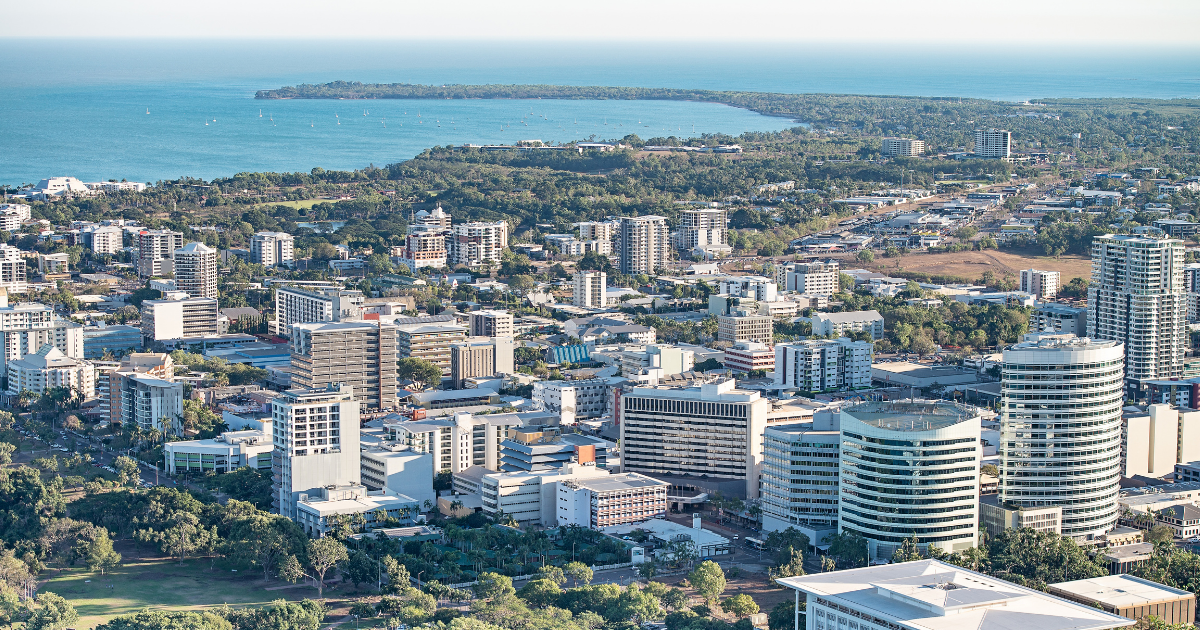
Even though we all know it is hot in Darwin, do we really understand what it feels like to live through it? Thank you, Ann, for sharing your NT heat experiences with us.
Ann grew up in NSW but had visited the Northern Territory a number of times, so it wasn’t all totally new to her when she moved to Darwin. Ann rents a house in a coastal suburb where the occasional sea breeze offers some relief. The person who built this house had some unique ideas for passive cooling or “tropical cleverness” as Ann calls it. For instance, the bathroom, ensuite and toilet were all placed in the middle of the house, with no windows. To address ventilation, open slats were installed in the ceilings of these rooms, allowing hot air to rise into the ceiling cavity. Unfortunately, this design also allows the extremely hot air trapped in the roof to seep back into the living spaces. Combine that with poorly sealed doors, and heat flows freely into the rest of the house—even when the doors are shut.
On the rare occasions when a welcome breeze does blow through, it brings its own problems. The slatted ceilings allow thick layers of black dust from the roof space to fall into the rooms below, covering everything.
Ann tells us that most days in Darwin are around 32 degrees or higher, but when it stays at 30 overnight as well, that’s when sleep is almost impossible. During these nights, Ann pulls her mattress out to lay under the ceiling fan in the living area to try to get enough relief from the heat to fall asleep. “Although we do have air conditioning the house is not sealed well enough for the AC to work effectively so it is not worth turning it on and paying double the electricity bill to hardly feel any difference.”

Ann says, “it’s not just the high temperatures, but the high dew point that is the killer here.” The Dew point is often so high that it’s not unusual to see buses rolling down the street covered in condensation.
“During the wet season, humidity levels rise dramatically, and mould covers everything.”
The house faces west, so to block out the harsh afternoon sun, Ann has hung rubber-backed blackout curtains outside the western-facing windows. This helps, but the fierce Territory sun quickly degrades materials. Fabrics, plastics, and elastics all crumble after too much exposure—just one touch and they disintegrate into tiny pieces.
Heat stress is a serious issue in Darwin, not just for locals but especially for visitors who may not realise how dangerous the climate can be. Ann recently helped a young tourist who had collapsed on the footpath while riding a scooter to the markets. The woman had only gone a short distance from her accommodation to get food and water, but the heat overwhelmed her. Ann got her into the shade, gave her drinks, helped her cool down, and drove her back to her hotel, along with sharing a link to the NT Government’s heat advice website and this isn’t the first time Ann has helped people suffering from heat stress.
Whenever Ann and her family visit the cooler southern states, she sees a dramatic change in her children. Without the burden of heat stress, “they seem like completely different people.” Ann doesn’t think that her family will stay in Darwin long term, as living in the extreme heat takes a toll on everyone, physically and mentally.
Without the burden of heat stress, “they seem like completely different people.”

Ann would really like to see more climate-appropriate housing innovation. Most homes in Darwin are like those in Campbelltown or Melbourne, small windows and little thought for the local environment.
Ann told us that many scientists, experts and researchers from around the world come to Darwin to conduct studies here on heat, climate adaptation, and sustainable living, because if something can survive here in Darwin, it can survive anywhere.
The CSIRO has created the Darwin Living Lab to test and evaluate heat mitigation measures, and inform tropical urban design for Darwin by using real world experiments.
Our work is powered by community members coming together and taking local action together. Let’s bring together Darwin locals looking to take action in the Northern Territory – can you sign up as a volunteer today? Sign up here.

One response to “Ann, a Darwin local, shares her NT heat story with us.”
Darwin has always had extremes of climate even back in early 70s , I remember visiting heading to and from Singapore with my Dad who was Stationed in Singapore during the Vietnam War .
The high humidity was unbearably intense .
My ex partner and I visited so he could perform in the Darwin Symphony Orchestra for an International Guitar Festival in mid 2000s .
It was actually pleasant there , though we had aircon hotel room to retreat to and went swimming in Litchfield to cool off . Fine if you can handle the risk of Crocs .
Basically a tough place to live , fine if you have 24/7 access to a swimming pool .
I struggle enough living in the West Wimmera in summer heat , Darwin is really extreme.
There really needs to be climate adaptive housing especially for pensioners , low income earners and unemployed and homeless